- Table of Contents
- 1. Why International Patients Choose India for Heart Surgery
- The numbers that matter most
- 2. Metro Hospital Faridabad: What Makes It Different
- Founded on a record-breaking legacy
- Infrastructure and capacity
- International patient services
- 3. Cardiac Procedures Available for International Patients
- Surgical Procedures
- Interventional / Non-Surgical Procedures
- 4. Heart Surgery Cost in India vs UK, USA, and Dubai
- What is included in an Indian hospital package?
- 5. The Step-by-Step Patient Journey
- Step 1 — Initial Enquiry and Medical Review (Day 1–3)
- Step 2 — Cost Estimation (Day 2–4)
- Step 3 — Medical Visa Application (Day 4–14)
- Step 4 — Arrival and Pre-Surgical Evaluation (Day 1–3 in India)
- Step 5 — Surgery and Hospital Stay (Day 3–12 in India)
- Step 6 — Discharge and Recovery (Day 12–21 in India)
- Step 7 — Follow-Up from Home (Ongoing)
- 6. Medical Visa and Travel: Everything You Need to Know
- India e-Medical Visa Facts
- Getting to Faridabad
- 7. What to Expect After Surgery: Recovery and Follow-Up
- In-hospital recovery
- Before you fly home
- Remote follow-up
- 8. Country-Specific Patient Concerns
- UK Patients
- USA and Canadian Patients
- Gulf Region (UAE, Saudi Arabia, Kuwait, Qatar)
- African Patients (Nigeria, Kenya, Tanzania, Ethiopia, Ghana)
- Bangladesh and South Asian Patients
- 9. Frequently Asked Questions
- 10. Conclusion: Your Heart Health, Without the Financial Catastrophe
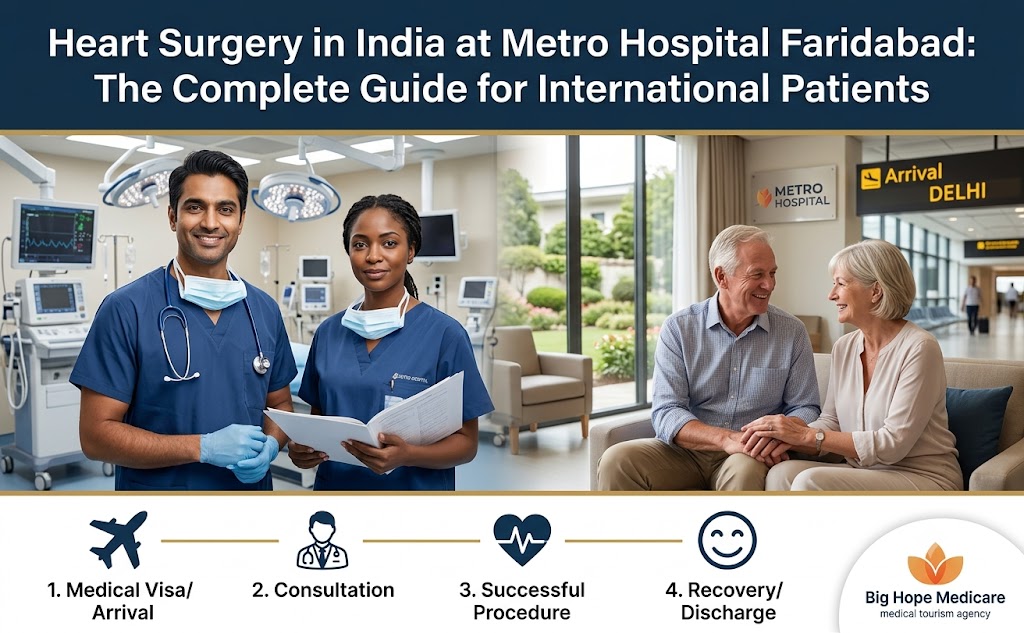
Heart Surgery in India at Metro Hospital Faridabad: Complete Guide for International Patients
⚠️ Medical Disclaimer: The information in this article is intended for informational purposes only and does not constitute medical advice. Always consult a qualified cardiac specialist before making treatment decisions. Cost figures are indicative ranges for international patients and may vary based on individual case complexity.
Every year, more than 50,000 international patients travel to India for cardiac procedures not because they cannot find surgeons at home, but because they find better ones here for a fraction of the price. India now accounts for roughly 18% of global medical tourism, and heart surgery is the single largest driver of that figure.
Metro Hospital and Heart Institute in Faridabad sits at the center of this story. Founded in 2002 and led by Padma Vibhushan awardee Dr. Purshotam Lal — one of the most decorated cardiologists in the world — the hospital has treated patients from over 45 countries, performing more than 75,000 angiographies and 10,000 cardiac surgeries over two decades of practice.
This guide answers every question a patient travelling from the UK, USA, Gulf countries, or Africa would reasonably ask before committing to cardiac treatment in India.
Table of Contents
- Why International Patients Choose India for Heart Surgery
- Metro Hospital Faridabad: What Makes It Different
- Cardiac Procedures Available for International Patients
- Heart Surgery Cost in India vs UK, USA, and Dubai
- The Step-by-Step Patient Journey
- Medical Visa and Travel: Everything You Need to Know
- What to Expect After Surgery: Recovery and Follow-Up
- Country-Specific Patient Concerns
- Frequently Asked Questions
- Conclusion and Next Steps
1. Why International Patients Choose India for Heart Surgery
The straightforward answer is quality at a price most patients can actually afford. But there is more to it than that.
India's top cardiac centres perform surgical volumes that most Western hospitals will never match. High volume creates expertise. Metro Hospital's cardiac team has completed tens of thousands of complex procedures — numbers that, in clinical research, consistently correlate with better patient outcomes and lower complication rates.
The numbers that matter most
|
Factor |
India (Top Hospitals) |
USA / UK |
|
CABG success rate |
95%+ |
94–96% (comparable) |
|
Average hospital wait time |
2–7 days |
3–6 months (NHS) |
|
CABG all-inclusive cost |
$5,000–$9,000 |
$70,000–$200,000 |
|
Joint Commission equivalent |
NABH / NABL / JCI |
JCI / CQC |
|
English-speaking staff |
Yes (widely) |
Yes |
|
International patient coordinators |
Dedicated team |
Limited to none |
Sources: India Ministry of Health (MOHFW) Medical Tourism Report 2023; PSRI Hospital CABG outcomes data; Treatment Possible cost comparison 2025–2026.
India's cardiac centres also offer something Western systems structurally cannot: speed. When a patient receives a CABG diagnosis in the UK, NHS waiting lists can extend to six months. The same patient can reach India, complete pre-operative testing, undergo surgery, and begin recovery in under two weeks.
2. Metro Hospital Faridabad: What Makes It Different
Founded on a record-breaking legacy
Metro Hospital and Heart Institute was established in 2002 by Dr. Purshotam Lal, the first interventional cardiologist in India to receive both the Padma Bhushan and the Padma Vibhushan — the country's two highest civilian honours. Dr. Lal holds the distinction of performing the largest number of angioplasties as a single operator, a record recognised by the Limca Book of Records.
That legacy has shaped the culture of the institution. The hospital was the first in Faridabad to perform TAVR (Transcatheter Aortic Valve Replacement) — a non-surgical alternative to open-heart valve replacement — and continues to pioneer minimally invasive approaches that reduce recovery time and surgical risk.
Infrastructure and capacity
- 400 hospital beds across the campus
- 147 ICU beds — one of the highest ratios in the Delhi NCR region
- 200+ specialist doctors covering 30+ medical disciplines
- 24/7 emergency and trauma centre with dedicated cardiac emergency protocols
- State-of-the-art catheterization laboratories (cath labs)
- North India's only TrueBeam Linac with HyperArc for oncology (multispecialty capability)
- NABH and NABL accredited — India's gold-standard hospital quality certifications
- 8-acre campus in Sector 16A, Faridabad — 60 minutes from Indira Gandhi International Airport
International patient services
Metro Hospital maintains a dedicated International Patients Desk reachable at International.desk@metrohospitalfaridabad.com. Services include:
- Pre-arrival case review and treatment cost estimation
- Medical visa invitation letter
- Airport transfer coordination
- Accommodation guidance (hotels adjacent to the campus)
- Interpreter services for Arabic, French, Swahili, and other languages
- Insurance documentation and billing support
- Post-discharge teleconsultation for follow-up from home country
3. Cardiac Procedures Available for International Patients
Metro Hospital offers the full spectrum of interventional and surgical cardiac care. The procedures most frequently sought by international patients are:
Surgical Procedures
|
Procedure |
Description |
Typical India Cost |
|
CABG (Heart Bypass) |
Coronary Artery Bypass Grafting — reroutes blood around blocked arteries |
$5,000–$9,000 |
|
Open-Heart Surgery |
Includes valve repair/replacement and structural heart corrections |
$5,500–$10,000 |
|
Valve Replacement (Surgical) |
Aortic or mitral valve replacement using tissue or mechanical valve |
$6,000–$11,000 |
|
Heart Transplant |
Available at select centres; requires compatibility evaluation |
$25,000–$40,000 |
|
Aortic Aneurysm Repair |
Surgical correction of enlarged aorta |
$7,000–$12,000 |
Interventional / Non-Surgical Procedures
|
Procedure |
Description |
Typical India Cost (USD) |
|
Coronary Angioplasty (PTCA) |
Balloon dilation of blocked coronary artery, with or without stent |
$3,000–$6,000 |
|
Coronary Angiography |
Diagnostic imaging of coronary arteries |
$800–$1,500 |
|
TAVR / TAVI |
Non-surgical aortic valve replacement via catheter |
$12,000–$18,000 |
|
Electrophysiology / Ablation |
Treatment for arrhythmias including AF ablation |
$5,000–$9,000 |
|
Pacemaker Implantation |
Single or dual chamber pacemaker |
$4,000–$7,000 |
|
ICD Implantation |
Implantable Cardioverter-Defibrillator for sudden cardiac arrest risk |
$5,000–$9,000 |
Note: Costs shown are indicative all-inclusive ranges for international patients at private NABH-accredited hospitals. Your actual quotation will depend on case complexity, number of vessels involved, pre-existing conditions, and length of stay. Request a personalised estimate by sending your recent medical reports to BigHope Medicare.
4. Heart Surgery Cost in India vs UK, USA, and Dubai
For most international patients, cost is the first question — and the most important one. Here is how India compares across the procedures patients most commonly enquire about:
|
Procedure |
India |
UK (Private) |
USA |
Dubai |
|
CABG (Heart Bypass) |
$5,000–$9,000 |
£20,000–£45,000 |
$70,000–$200,000 |
$25,000–$40,000 |
|
Valve Replacement |
$6,000–$11,000 |
£22,000–£50,000 |
$80,000–$180,000 |
$28,000–$45,000 |
|
TAVR / TAVI |
$12,000–$18,000 |
£35,000–£60,000 |
$80,000–$120,000 |
$35,000–$55,000 |
|
Coronary Angioplasty |
$3,000–$6,000 |
£8,000–£18,000 |
$20,000–$50,000 |
$12,000–$20,000 |
|
Angiography (diagnostic) |
$800–$1,500 |
£2,000–£5,000 |
$5,000–$15,000 |
$2,500–$5,000 |
Sources: Treatment Possible (2025–2026); CureMeAbroad (2026); ShifamHealth CABG cost guide; NHS published procedure costs; GoAid India vs USA comparison.
What is included in an Indian hospital package?
When a reputable hospital quotes an all-inclusive figure, it typically covers:
- Pre-surgical investigations: ECG, echocardiogram, blood panel, chest X-ray, angiography if required
- Surgeon, anaesthesiologist, and assistant surgeon fees
- Operating theatre and ICU charges
- Hospital stay (standard CABG: 7–10 days total, 3–5 in ICU)
- All medications during admission
- Nursing care and physiotherapy
- Airport transfer (offered by many hospitals)
- Post-operative teleconsultation after discharge
It does not typically include: international flights, hotel accommodation for accompanying family, personal expenses, or complications requiring extended stay. Always confirm inclusions in writing before travel.
Even accounting for return flights from London (~£600), a week of hotel accommodation (~£500), and incidentals, a UK patient having CABG in India typically saves between £18,000 and £40,000 compared to UK private care.
5. The Step-by-Step Patient Journey
International patients often ask: 'How does this actually work?' Here is the standard pathway from enquiry to return home.
Step 1 — Initial Enquiry and Medical Review (Day 1–3)
Send your recent medical reports — angiogram report, echocardiogram, blood reports, and any cardiac specialist notes to the hospital or to BigHope Medicare. A cardiac specialist reviews the file and provides an opinion on the recommended procedure within 24–72 hours.
Step 2 — Cost Estimation (Day 2–4)
Based on the medical review, you receive a detailed cost estimate. This is not a binding quote — actual costs are confirmed after in-person pre-surgical evaluation but it is accurate enough to plan your travel budget.
Step 3 — Medical Visa Application (Day 4–14)
India offers a dedicated e-Medical Visa for patients travelling for treatment. Apply at indianvisaonline.gov.in. You will need:
- Scanned passport (valid for at least 6 months)
- Invitation letter from the hospital (Metro Hospital's International Desk provides this)
- Recent passport photograph
- Proof of funds
- Medical documents supporting the need for treatment
Processing time is typically 3–5 business days. The e-Medical Visa allows a 60-day stay with two extensions possible. One companion (spouse, parent, or adult child) may apply for an e-Medical Attendant Visa simultaneously.
Step 4 — Arrival and Pre-Surgical Evaluation (Day 1–3 in India)
The hospital's international patient coordinator meets you at the airport or designated hotel. Over 1–3 days, the cardiac team conducts in-person evaluations: physical examination, fresh blood work, ECG, and any imaging not done in your home country. The surgical team finalises the operative plan.
Step 5 — Surgery and Hospital Stay (Day 3–12 in India)
CABG patients typically spend 3–5 days in the cardiac ICU followed by 4–6 days in a standard room. The cardiac team conducts daily rounds. Family attendants may stay in the patient's room or in adjacent accommodation at nominal cost.
Step 6 — Discharge and Recovery (Day 12–21 in India)
Most patients are medically fit for the return flight within 10–14 days of surgery. The hospital issues a detailed discharge summary, medication list, and follow-up protocol for your home country physician. A staggered-fare airline ticket (flexible return date) is strongly recommended.
Step 7 — Follow-Up from Home (Ongoing)
Metro Hospital's International Desk conducts teleconsultations at the 1-month and 3-month marks. All lab reports and imaging from the home country can be shared digitally for review.
6. Medical Visa and Travel: Everything You Need to Know
India e-Medical Visa Facts
|
Detail |
Information |
|
Portal |
indianvisaonline.gov.in |
|
Visa type |
e-Medical Visa (eMV) |
|
Validity |
60 days from date of arrival; extendable twice (total up to 180 days) |
|
Processing time |
3–5 business days (apply at least 4 days before travel) |
|
Companion visa |
e-Medical Attendant Visa — one companion per patient |
|
Countries eligible |
Available to citizens of most countries; check the portal for your nationality |
|
Fee |
Varies by nationality; typically USD 25–100 |
|
Entry |
Single-entry (can be extended within India if required) |
Getting to Faridabad
- Fly into Indira Gandhi International Airport (DEL), New Delhi served by most major international airlines
- Metro Hospital is approximately 55–65 minutes by road from the airport (45 km via NH-48)
- The hospital coordinates airport transfers for international patients
- The nearest Delhi Metro station to the hospital is approximately 1.6 km away
- Multiple hotels rated 3–5 stars are within 2 km of the hospital campus for family members
7. What to Expect After Surgery: Recovery and Follow-Up
Recovery from heart surgery in India follows the same clinical protocols as any accredited Western centre. What differs is the support structure available to international patients.
In-hospital recovery
- Physiotherapy begins within 24 hours of ICU discharge
- Dedicated cardiac rehabilitation nurses guide breathing exercises and ambulation
- Dietary counselling for post-cardiac diet (adjusted for your home country's ingredients)
- Daily multi-disciplinary review including cardiologist, cardiac surgeon, and rehab team
Before you fly home
The treating team will advise on fitness to fly based on your specific recovery trajectory. For CABG patients, the typical recommendation is 10–14 days post-operation before a long-haul flight. You will receive:
- Comprehensive discharge summary (translated if required)
- Minimum 2-week supply of all prescribed medications
- Letter for airline explaining medical fitness to fly
- Contact details for the International Desk for any post-discharge concerns
Remote follow-up
The hospital's International Patient Department conducts video consultations at 4 weeks and 12 weeks post-discharge. Routine investigations can be done in your home country and results shared digitally for review by your Metro Hospital team.
8. Country-Specific Patient Concerns
UK Patients
The most common concern from UK patients is NHS treatment timelines. Elective cardiac surgery on the NHS currently carries waiting times of 3–6 months for non-emergency procedures. Patients who cannot wait particularly those with unstable angina or multiple-vessel disease — frequently find that travelling to India and returning within 3 weeks costs less than a single month of lost earnings from delayed treatment.
UK patients should confirm whether their private health insurer covers overseas treatment several UK insurers do, including AXA PPP Healthcare and Bupa International. Even without insurance, the total cost including travel for CABG in India is typically 70–85% less than equivalent UK private care.
USA and Canadian Patients
For US patients without insurance, or those with high deductibles, India offers surgical savings of $65,000–$190,000 on CABG alone. Many US-based cardiac patients cite the deductible ($5,000–$12,000) as comparable to the total India package price.
Patients from the USA and Canada should obtain a travel insurance policy that covers medical evacuation and pre-existing conditions. Most India hospitals can provide documentation to support insurance claims or HSA/FSA submissions.
Gulf Region (UAE, Saudi Arabia, Kuwait, Qatar)
Gulf patients represent one of the largest international cohorts at Indian cardiac centres, largely because of cultural familiarity, geographic proximity (3–4 hours flying time), and Arabic-speaking patient coordinators. The e-Medical Visa process is straightforward for most GCC nationals.
The combination of halal dietary options, prayer facilities within hospital campuses, and Arabic-speaking support staff makes Metro Hospital a comfortable choice for observant Muslim patients.
African Patients (Nigeria, Kenya, Tanzania, Ethiopia, Ghana)
Indian cardiac centres treat thousands of African patients annually, and Metro Hospital is no exception. Key considerations:
- Swahili and French interpreter services available (confirm in advance)
- Dedicated coordinator for West African and East African patient pathways
- Medical facilities in many African countries lack the diagnostic imaging needed pre-surgery Metro Hospital can perform all pre-operative investigations on arrival
- The e-Medical Visa is available to citizens of most African nations
Bangladesh and South Asian Patients
Patients from Bangladesh, Nepal, and Sri Lanka often choose Faridabad-based hospitals due to the overland/short-flight proximity and the prevalence of Hindi and Bengali-speaking staff. The cost advantage over Bangkok or Singapore alternatives is significant, and cultural familiarity reduces the stress of medical travel.
9. Frequently Asked Questions
How much does heart bypass surgery cost at Metro Hospital Faridabad?
An all-inclusive CABG (heart bypass surgery) package at Metro Hospital Faridabad typically ranges from USD 5,000 to USD 9,000 for international patients. This includes pre-surgical investigations, surgeon and anaesthetist fees, ICU and ward stay, medications, and nursing care. Your exact cost depends on the number of vessels bypassed, complexity, and length of hospital stay. Send your medical reports for a personalised estimate.
Is Metro Hospital Faridabad accredited?
Yes. Metro Hospital and Heart Institute is accredited by NABH (National Accreditation Board for Hospitals and Healthcare Providers) and NABL (National Accreditation Board for Testing and Calibration Laboratories) — India's highest quality standards for healthcare institutions, comparable to JCI accreditation internationally.
What is the success rate of heart surgery in India?
India's leading cardiac hospitals report CABG success rates of 95% or above, comparable to outcomes at top US and UK centres. Metro Hospital's cardiac team has completed over 10,000 cardiac surgeries with outcomes data available on request.
How do I apply for an Indian medical visa?
Apply for an e-Medical Visa at indianvisaonline.gov.in. You will need your passport, a hospital invitation letter (provided by Metro Hospital's International Desk), recent medical documents, and proof of funds. Processing takes 3–5 business days. One family member can simultaneously apply for an e-Medical Attendant Visa.
How long will I need to stay in India for heart bypass surgery?
Most CABG patients require a total stay of 14–21 days in India: 2–3 days for pre-surgical evaluation, 7–10 days hospitalisation (3–5 in ICU, remainder in ward), and 4–7 days for early recovery and medical clearance to fly. The medical team advises on your specific readiness for travel.
Can I bring a family member with me?
Yes. The e-Medical Attendant Visa allows one companion to travel with you. The hospital can arrange shared accommodation options near the campus. Family members may stay in the patient's hospital room during the ward stay at minimal additional cost.
Does Metro Hospital have English-speaking staff?
Yes. English is the primary working language for medical documentation and patient communication at Metro Hospital. The International Patients Desk has dedicated coordinators experienced in managing international cases, and interpreter services are available for Arabic, French, Swahili, and other languages.
What should I bring to India for cardiac treatment?
Bring all recent medical records (angiogram report, echocardiogram, stress test, blood reports), a list of current medications with dosages, a minimum 2-week supply of your regular medications, valid passport, travel and medical insurance documents, and emergency contact information. The hospital will conduct fresh investigations on arrival.
10. Conclusion: Your Heart Health, Without the Financial Catastrophe
Heart disease does not negotiate on timing. When a cardiologist recommends bypass surgery or a valve replacement, the clock starts.
For patients in countries where waiting times stretch into months and private care costs more than a house, India offers something genuinely different: equivalent surgical expertise, comparable outcomes, accredited institutions, and a total cost that makes treatment possible rather than optional.
Metro Hospital and Heart Institute in Faridabad has been building that record since 2002 — 75,000 angiographies, 10,000 cardiac surgeries, patients from over 45 countries, and a founding cardiologist whose work changed the field. The track record is there.
The question is whether your circumstances allow you to act on it.
Ready to Find Out If Metro Hospital is Right for You?
- Send your medical reports for a free review get a specialist opinion within 48 hours
- Receive a personalised cost estimate with no obligation
- Talk to a patient coordinator who has helped hundreds of international patients plan their journey