- (Costs, Hospitals & How Big Hope Medicare Helps You Plan It)
- Why International Patients Are Choosing India in 2026
- 1. The cost gap is no longer marginal it's structural
- 2. Accreditation has closed the "quality gap" perception
- 3. Government policy is actively removing friction
- 4. Volume drives outcomes, not just price
- Cost Comparison: India vs. the USA for Common Procedures
- What Makes Big Hope Medicare Different
- Treatments Patients Book Most Often
- A Realistic Patient Journey Timeline
- Frequently Asked Questions
- The Bottom Line
Medical Tourism in India: The Complete 2026 Guide
(Costs, Hospitals & How Big Hope Medicare Helps You Plan It)
India isn't just a medical tourism destination anymore it's becoming the default one for a growing share of the world. Government data shows over 507,000 foreign nationals traveled to India specifically for treatment in 2025, and independent market analysts put India's medical tourism industry at roughly $20 billion in 2026, expanding at more than 12% a year through the next decade. Bangladesh is currently the single largest source country, followed by patients from Iraq, Uzbekistan, and Somalia, alongside a steadily rising number from the UK, US, and Gulf states.
The reason isn't complicated: the same surgery that costs $150,000 in the United States can cost under $8,000 at a JCI-accredited hospital in India performed by a surgeon who may do ten times the case volume of their Western counterpart in a single year. But "cheaper" only matters if the care, the logistics, and the aftercare are handled properly. That's the part most guides skip, and it's the part Big Hope Medicare exists to solve.
This guide breaks down what's actually driving India's medical tourism boom in 2026, what treatments cost compared to the West, and exactly what a properly managed medical journey with Big Hope Medicare looks like from your first call to your flight home.
Why International Patients Are Choosing India in 2026
1. The cost gap is no longer marginal it's structural
Healthcare pricing in the US and UK reflects malpractice insurance, administrative overhead, and specialist scarcity that simply don't exist at the same scale in India. Patients typically save 60–80% compared to OECD-country private pricing, and for high-cost procedures like cardiac surgery, savings of $100,000+ are common even after adding flights, accommodation, and a companion's expenses.
2. Accreditation has closed the "quality gap" perception
India now has a growing pipeline of NABH-accredited hospitals with capacity projected to exceed 2,000 by 2028 alongside a smaller but well-established group of JCI-accredited centers concentrated in Delhi NCR, Mumbai, and Bangalore. These use the same equipment, the same surgical protocols, and in many cases surgeons trained or fellowship-certified in the UK, US, or Germany.
3. Government policy is actively removing friction
India's "Heal in India" campaign has pushed e-Medical Visa approval down to 48–72 hours, extended eligibility to 167 countries, and is rolling out a unified Medical Value Travel portal for real-time bed availability. None of this existed in a coordinated form five years ago it's a genuinely different (and easier) experience to plan a medical trip to India today than it was even in 2022.
4. Volume drives outcomes, not just price
Cardiovascular treatment alone accounts for roughly a third of India's medical tourism revenue, and high-volume centers like Narayana Health in Bengaluru and Asian Heart Institute in Mumbai report bypass success rates above 99% figures that stand up against, and in some published comparisons exceed, major Western centers. Surgical proficiency scales with repetition, and Indian cardiac teams frequently perform in a month what a mid-sized Western hospital performs in a year.
Cost Comparison: India vs. the USA for Common Procedures
Numbers convince faster than adjectives. Here's how commonly booked procedures compare, based on current 2026 market pricing data:
| Procedure | Cost in India vs. USA (2026 estimates) |
|---|---|
| Heart Bypass Surgery (CABG) | $5,000–$8,500 in India vs. $150,000–$200,000 in the US |
| TAVR (Heart Valve Replacement) | $25,000–$35,000 in India vs. $80,000+ in the US |
| Total Knee Replacement | ~$6,500–$8,000 in India vs. $35,000–$50,000 in the US |
| IVF (per cycle) | ~$2,500–$4,000 in India vs. $15,000–$20,000 in the US |
| Full Mouth Dental Implants | ~$3,000–$5,000 in India vs. $25,000–$40,000 in the US |
Figures are indicative 2026 market ranges and vary by hospital, surgeon, and individual case complexity Big Hope Medicare provides an exact, itemized quote after reviewing your medical reports.
What Makes Big Hope Medicare Different
Cost comparisons are everywhere online. What's harder to find is a partner who actually manages the parts that go wrong when patients try to arrange this themselves the wrong hospital for their specific condition, a visa delay, no one meeting them at the airport, or a language barrier in the ICU. Here's what that looks like in practice:
| What You Need | How Big Hope Medicare Handles It |
|---|---|
| Choosing the right hospital | Matches your condition to NABH/JCI-accredited hospitals and specialists with a proven track record for that specific procedure not just the biggest brand name |
| A second opinion before committing | Coordinates independent second medical opinions so you're deciding on a diagnosis, not a sales pitch |
| Medical visa process | Guides the e-Medical Visa application so it's filed correctly the first time, avoiding the delays that trip up self-arranged trips |
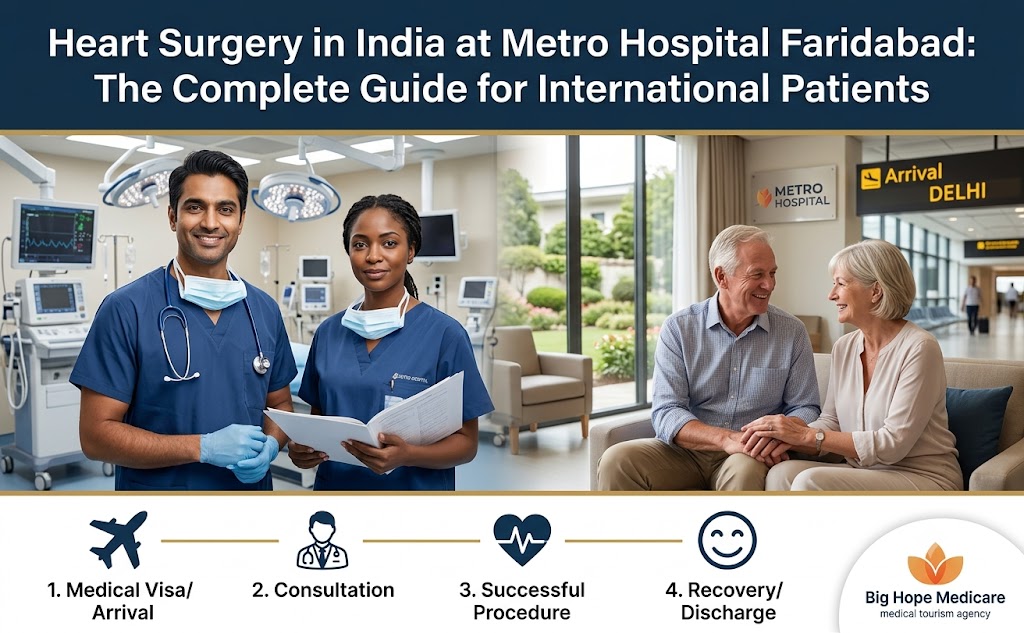
| Arrival and logistics | Airport pickup, accommodation for you and any companion, and a dedicated coordinator for the full stay |
| Communication | Interpreters for major source-country languages, so nothing gets lost between you and your care team |
| Aftercare | 24/7 support during recovery and a structured follow-up plan before you fly home |
| Pricing transparency | One clear, itemized quote up front no hidden facilitator markups added mid-treatment |
Treatments Patients Book Most Often
Through Big Hope Medicare's hospital network, the most requested categories are:
- Cardiac Surgery — CABG, valve replacement, TAVR, angioplasty
- Orthopedic Procedures — knee and hip replacement, spine surgery
- Organ Transplants — kidney and liver transplant programs
- Cancer Treatment — surgical oncology, chemotherapy, radiation
- IVF & Fertility Treatment — IVF, ICSI, fertility preservation
- Cosmetic & Reconstructive Surgery
If you don't see your condition listed, that's not a limitation — it usually just means the specific treatment page hasn't been published yet. Reach out directly and the team will match you to the right specialist.
A Realistic Patient Journey Timeline
- Day 1–2: Share your medical reports for a free evaluation and a specialist-reviewed treatment plan.
- Day 3–5: Receive an itemized cost quote and, if requested, a second opinion from an independent specialist.
- Week 1–2: e-Medical Visa filed and processed (typically 48–72 hours once submitted correctly).
- Arrival: Airport pickup, hospital admission, pre-op diagnostics.
- Treatment: Procedure performed at your matched hospital, with a dedicated patient coordinator throughout.
- Recovery: Post-op monitoring, physiotherapy or rehab as needed, "fit to fly" clearance.
- Follow-up: Structured teleconsultation check-ins after you return home.
Frequently Asked Questions
Is medical treatment in India actually safe for international patients? Yes, at accredited hospitals. NABH and JCI accreditation both require hospitals to meet documented international patient-safety and clinical-outcome standards, which is why Big Hope Medicare only partners with accredited centers.
How much can I realistically save by traveling to India for treatment? Most patients save 60–80% versus private treatment costs in the US, UK, or Gulf region, even after factoring in flights and accommodation though the exact figure depends on your specific procedure.
How long does the medical visa take? Under India's streamlined e-Medical Visa process, approval typically takes 48–72 hours once the application is filed correctly, and it currently covers patients from 167 countries.
Can my family stay with me during treatment? Yes. Big Hope Medicare arranges accommodation for a companion and can extend a medical attendant visa where required.
Do I need to travel again for follow-up care? Not usually. Most post-op follow-up is handled through structured teleconsultations with your surgical team, with an in-person visit only if your specific case requires it.
The Bottom Line
India's medical tourism industry isn't growing because it's the cheapest option on paper it's growing because accreditation, government policy, and surgical volume have converged to make it a genuinely credible option for serious procedures, not just elective ones. The risk was never "is Indian healthcare good enough" modern outcome data has answered that. The real risk is trying to coordinate hospital selection, visas, logistics, and aftercare on your own, from another country, while also managing a health condition.
That coordination is the actual service Big Hope Medicare provides. If you're evaluating treatment options abroad, start with a free evaluation of your medical reports you'll get a specialist-reviewed plan and an itemized quote before you commit to anything.
Sources: India Ministry of Tourism (Heal in India / Medical Value Travel data, 2025–2026), Ministry of External Affairs e-Medical Visa statistics, Mordor Intelligence India Medical Tourism Market Report (2026), Future Market Insights India Medical Tourism Market analysis (2026). Cost figures are indicative market ranges for 2026 and will vary by hospital, surgeon, and case complexity; always confirm with an itemized quote based on your medical reports.