- Introduction
- Understanding Oncology Treatment Guidelines
- Importance of Structured Cancer Treatment Planning
- Major Approaches in Cancer Treatment
- Personalized Cancer Treatment Planning
- The Patient Journey in Oncology Care
- Challenges in Cancer Treatment Planning
- Role of Care Coordination and Support Systems
- Importance of Trusted Guidance in Oncology Care
- Conclusion
Oncology Treatment Guidelines: Modern Cancer Care Guide.
Introduction
Oncology treatment guidelines are structured medical frameworks that help doctors and healthcare teams decide the most appropriate and effective way to manage cancer. These guidelines are not a single fixed rule; instead, they are a combination of carefully developed clinical practices, patient evaluation methods, and evidence-based treatment approaches designed to ensure that every patient receives the most suitable care for their condition.
Cancer is a complex disease, and it affects every patient differently. The same type of cancer may behave differently in different individuals depending on its stage, location, and overall health condition of the patient. This is why oncology treatment guidelines are essential—they help bring consistency, safety, and clarity into treatment decisions while still allowing personalized care.
In modern healthcare systems, these guidelines also support communication between specialists, help in treatment planning, and ensure that patients receive structured care pathways that improve outcomes and reduce confusion during a difficult medical journey. For patients exploring treatment options, Oncology Treatment in India | Affordable Cancer Care provides deeper insight into advanced and cost-effective care approaches aligned with these medical guidelines.
Understanding Oncology Treatment Guidelines
Oncology treatment guidelines are essentially a set of recommended clinical pathways used by medical professionals to diagnose, stage, and treat cancer effectively. These guidelines are developed through continuous clinical research, expert medical experience, and evolving treatment technologies.
They serve several important purposes:
- Helping healthcare providers choose the right treatment approach
- Ensuring standardized and safe patient care
- Supporting early detection and accurate diagnosis
- Reducing unnecessary or ineffective treatments
- Improving overall treatment success rates
Rather than being rigid instructions, these guidelines act as a roadmap. Doctors still make final decisions based on individual patient conditions, but the guidelines provide a strong foundation for choosing the right path.
In cancer care, time and accuracy are extremely important. Even small delays or incorrect decisions can impact outcomes. Oncology treatment guidelines help reduce these risks by providing structured decision-making frameworks.
Importance of Structured Cancer Treatment Planning
Cancer treatment is not a one-step process. It requires a carefully planned sequence of actions, which may include diagnosis, staging, treatment selection, monitoring, and follow-up care. Oncology treatment guidelines play a vital role in ensuring that each of these steps is properly coordinated.
One of the most important benefits of these guidelines is that they improve decision-making consistency. Patients receiving care in different places or from different specialists can still benefit from similar standards of treatment planning.
Another key advantage is patient safety. Since cancer treatments can sometimes be intensive, guidelines help ensure that treatments are chosen based on proven effectiveness and patient suitability, reducing unnecessary risks.
These guidelines also help in:
- Identifying the most suitable first-line treatment
- Determining when to combine multiple therapies
- Recognizing treatment resistance or progression
- Planning long-term follow-up care
Most importantly, structured guidelines give patients clarity. When patients understand that their treatment is based on well-established medical frameworks, it builds trust and confidence throughout the journey.
Major Approaches in Cancer Treatment
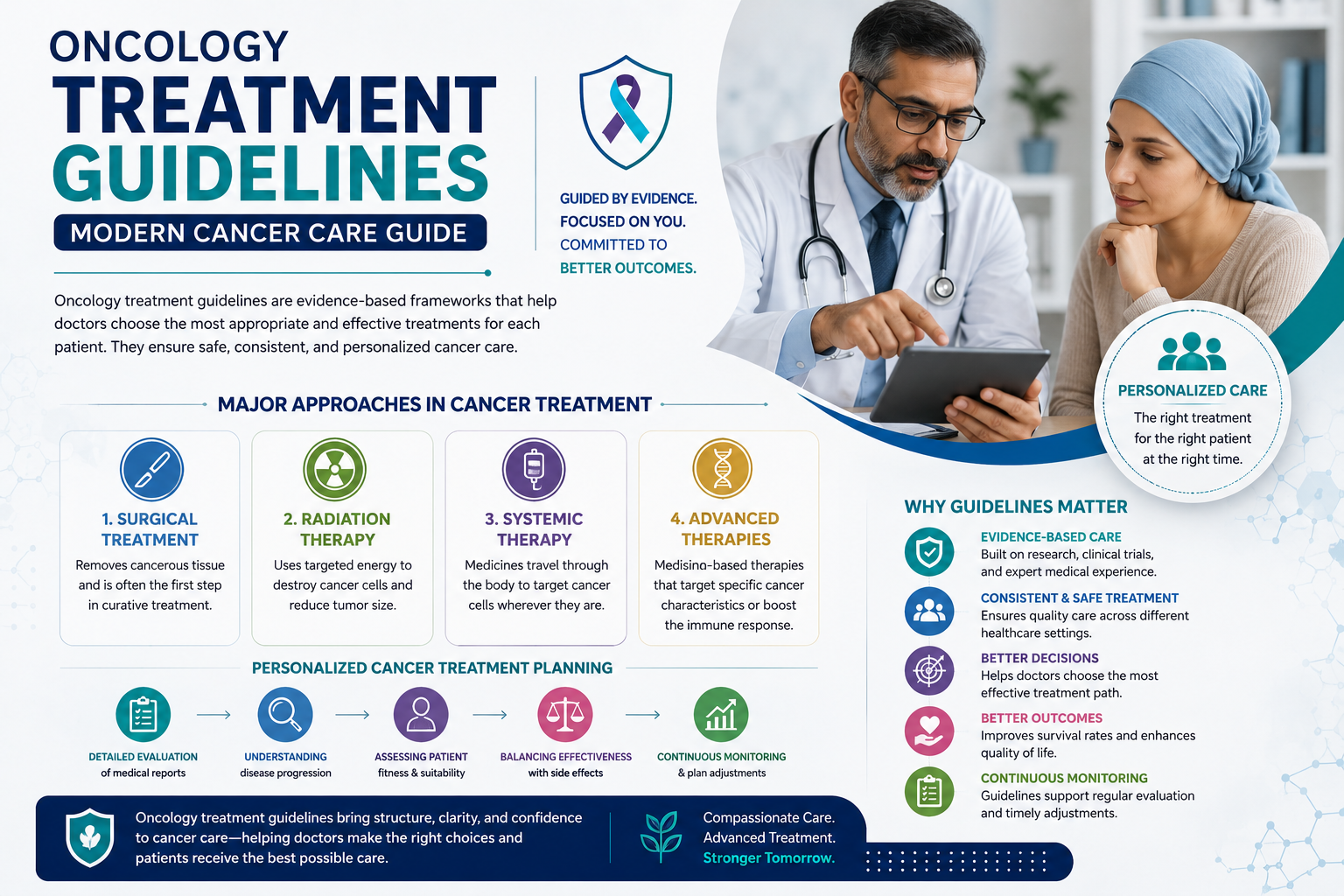
Oncology treatment guidelines include multiple treatment approaches, and the choice depends on the type and stage of cancer. Often, more than one method is used together to achieve better outcomes.
1. Surgical Treatment
Surgery is one of the most common approaches when cancer is localized. The main goal is to remove cancerous tissue from the body. In many cases, surgery is used at early stages or as part of a combined treatment plan.
Guidelines help determine:
- Whether surgery is appropriate
- How much tissue should be removed
- Whether additional treatments are needed after surgery
2. Radiation Therapy
Radiation therapy uses controlled energy to target cancer cells. It is often used when surgery is not possible or as a follow-up treatment after surgery. It may also be combined with other therapies to reduce tumor size or control growth.
3. Systemic Therapy
Systemic treatments circulate throughout the body and are designed to target cancer cells wherever they may be present. This includes approaches that help slow down or stop cancer cell growth.
These treatments are often used when cancer has spread beyond its original location.
4. Advanced Medical Therapies
Modern oncology also includes advanced treatment methods that are designed to improve precision and reduce damage to healthy cells. These may include therapies that target specific characteristics of cancer cells or boost the body’s immune response.
Guidelines help determine when these advanced options should be used and how they should be combined with other treatments.
Personalized Cancer Treatment Planning
One of the most important aspects of modern oncology treatment guidelines is personalization. No two patients are exactly the same, even if they have the same type of cancer. Factors such as age, overall health, stage of disease, and response to previous treatments all influence the final treatment plan.
Personalized treatment planning includes:
- Detailed evaluation of medical reports
- Understanding disease progression
- Assessing patient fitness for different therapies
- Balancing effectiveness with side effects
- Continuous monitoring and adjustment
This approach ensures that treatment is not just medically effective but also practical and manageable for the patient.
Personalization also helps in identifying when a treatment is no longer effective. In such cases, guidelines help doctors adjust the plan and explore alternative options instead of continuing ineffective treatments.
The Patient Journey in Oncology Care
Cancer treatment is a journey that involves multiple stages, each requiring careful coordination. Oncology treatment guidelines help structure this journey so that patients receive continuous and organized care.
Step 1: Diagnosis and Evaluation
The process begins with identifying symptoms and conducting diagnostic tests. Accurate diagnosis is essential for determining the type and stage of cancer.
Step 2: Treatment Planning
Once the condition is understood, a treatment plan is created. This plan may include one or more treatment methods based on medical guidelines.
Step 3: Treatment Execution
This stage involves starting the recommended treatment, which may include surgery, therapy sessions, or combined approaches.
Step 4: Monitoring Progress
During treatment, regular monitoring is essential. This helps in tracking progress and identifying any changes in the condition.
Step 5: Follow-Up Care
Even after initial treatment, continuous follow-up is important to ensure recovery and manage long-term health.
Each of these stages is guided by structured oncology principles that ensure the patient receives consistent care throughout their journey.
Challenges in Cancer Treatment Planning
Despite advancements in medical science, cancer treatment still presents several challenges. One of the biggest challenges is the complexity of the disease itself. Cancer does not behave the same way in every patient, making standardized treatment difficult without flexibility in guidelines.
Other challenges include:
- Variation in patient response to treatment
- Side effects of intensive therapies
- Late-stage diagnosis in many cases
- Emotional and psychological stress
- Need for continuous treatment adjustments
Oncology treatment guidelines help manage these challenges by offering structured frameworks while still allowing individualized care decisions.
However, medical expertise and proper coordination remain essential in applying these guidelines effectively.
Role of Care Coordination and Support Systems
In modern healthcare, treatment is not just about medical procedures—it is also about guidance, communication, and support. This is where healthcare coordination platforms play an important role.
BigHope Medicare focuses on acting as a strong bridge between patients and advanced medical care systems. The goal is to simplify the treatment journey and ensure that patients receive the right guidance at the right time.
Key support services include:
- Understanding each patient’s medical situation in detail
- Connecting patients with relevant specialists
- Helping interpret treatment options in simple terms
- Supporting appointment scheduling and coordination
- Providing assistance throughout the treatment journey
Such support systems are especially important in oncology care, where decisions are time-sensitive and emotionally challenging. Having structured guidance helps patients feel more confident and less overwhelmed.
Another important aspect is transparency. Patients are guided through treatment options, potential approaches, and general cost considerations so they can make informed decisions without confusion.
Additionally, access to a verified network of multi-specialty healthcare options ensures that patients can receive comprehensive care under one coordinated system. For patients looking for trusted and cost-effective healthcare solutions, Big HopeMedicare - Affordable Medical Treatment in India offers a reliable pathway to advanced treatment support and hospital coordination
Importance of Trusted Guidance in Oncology Care
Cancer treatment requires not only advanced medical technology but also trusted guidance. Patients often face uncertainty when choosing between multiple treatment options or understanding complex medical terms.
Structured guidance ensures:
- Clear understanding of diagnosis and treatment options
- Reduced confusion during decision-making
- Better coordination between specialists
- Improved patient confidence and emotional support
When patients receive proper guidance, they are more likely to follow treatment plans effectively and stay engaged throughout the process.
Healthcare support systems play a vital role in ensuring that patients are not alone during their journey and that every step is carefully explained and managed.
Conclusion
Oncology treatment guidelines form the backbone of modern cancer care. They ensure that treatment decisions are structured, evidence-based, and adaptable to each patient’s unique condition. From diagnosis to follow-up care, these guidelines help create a clear pathway that improves safety, effectiveness, and patient confidence.
Cancer treatment is a complex journey, but with the right guidance, structured planning, and coordinated care, patients can navigate it with greater clarity and support.
Organizations like BigHope Medicare play an important role in bridging the gap between patients and advanced healthcare systems. By offering guidance, coordination, and access to specialized care, they help ensure that every patient receives timely and informed treatment decisions.
In the end, oncology treatment guidelines are not just medical instructions—they are a structured support system designed to bring clarity, consistency, and hope into cancer care journeys.
Frequently Asked Questions (FAQs)
Question 1: What are oncology treatment guidelines?
Answer:
Oncology treatment guidelines are structured medical frameworks used to plan and manage cancer care. They help doctors choose appropriate treatments based on cancer type, stage, and patient health. These guidelines ensure evidence-based decisions, improve treatment consistency, and support safe, effective, and personalized cancer care throughout the entire treatment journey.
Question 2: Why are oncology treatment guidelines important in cancer care?
Answer:
Oncology treatment guidelines are important because they standardize cancer treatment and reduce medical uncertainty. They help healthcare professionals select the most effective therapies while ensuring patient safety. These guidelines also improve diagnosis accuracy, treatment planning, and coordination between specialists, leading to better outcomes and more structured cancer care management.
Question 3: What treatment options are included in oncology guidelines?
Answer:
Oncology treatment guidelines include surgery, radiation therapy, systemic treatments, and advanced targeted therapies. Depending on cancer type and stage, doctors may use one or a combination of these approaches. The goal is to remove or control cancer cells effectively while minimizing side effects and improving long-term patient survival and recovery.
Question 4: How do oncology guidelines support personalized cancer treatment?
Answer:
Oncology guidelines support personalized cancer treatment by considering each patient’s condition, including cancer stage, overall health, and response to therapy. Doctors use these guidelines to customize treatment plans, adjust therapies when needed, and ensure the most effective and safe approach for individual patients throughout their cancer care journey.
Question 5: How does care coordination improve cancer treatment outcomes?
Answer:
Care coordination improves cancer treatment outcomes by connecting patients with the right specialists, ensuring timely diagnosis, and simplifying treatment planning. Platforms like BigHope Medicare help bridge communication gaps, provide expert guidance, and support patients throughout their treatment journey, making cancer care more organized, transparent, and effective.